
RESOURCES TO HELP YOU

Self-help guides for common ailments
DIGESTION & STRESS
You may have noticed a feeling of unease in your stomach during times of stress. That’s because anxiety and worry can upset the delicate balance of digestion.
In some people, stress slows down digestion, causing bloating, pain and constipation, while in others it speeds it up, causing diarrhoea and frequent trips to the loo. Some people lose their appetite completely.
Stress can also worsen digestive conditions like stomach ulcers and irritable bowel syndrome.
Managing and reducing stress can help with your digestion.
Shiatsu techniques, such as gentle pressure, stretching, and rhythmic movements, can promote relaxation and help reduce stress levels. By stimulating the body’s relaxation response, Shiatsu can calm the nervous system and induce a sense of tranquility, which can be beneficial for managing stress, anxiety and digestive issues caused by stress.
Acupressure & self-help techniques
According to Traditional Chinese Medicine, specific acupressure points can help regulate digestion, alleviate symptoms, and promote a healthy digestive system.
Here are a few commonly used acupressure points related to digestion:
Stomach 36 (ST 36) or “Leg Three Miles”: Located on the outside border of the leg, about four finger widths below the kneecap. It is believed to strengthen the digestive system, relieve stomach discomfort, and boost energy.
Pericardium 6 (PC 6) or “Inner Gate”: Found on the inner forearm, about three finger widths above the wrist crease. It is commonly used for relieving nausea, vomiting, and indigestion.
Large Intestine 4 (LI 4) or “Union Valley”: Situated in the webbing between the thumb and index finger. This point is believed to promote healthy bowel movements and relieve constipation.

MENTAL HEALTH & RELAXATION
Exploring relaxation can help you look after yourself when you’re feeling stressed or worried. Relaxation might not make what you are stressed or worried about go away. But it can give you a mental break from these feelings and help you refocus.
There are lots of relaxation exercises out there. Many can be done in a short time with no equipment. Have a look at the tips and ideas below to see how relaxation can fit into your daily life.
Don’t worry if some ideas don’t work for you. Just try the ones that do.
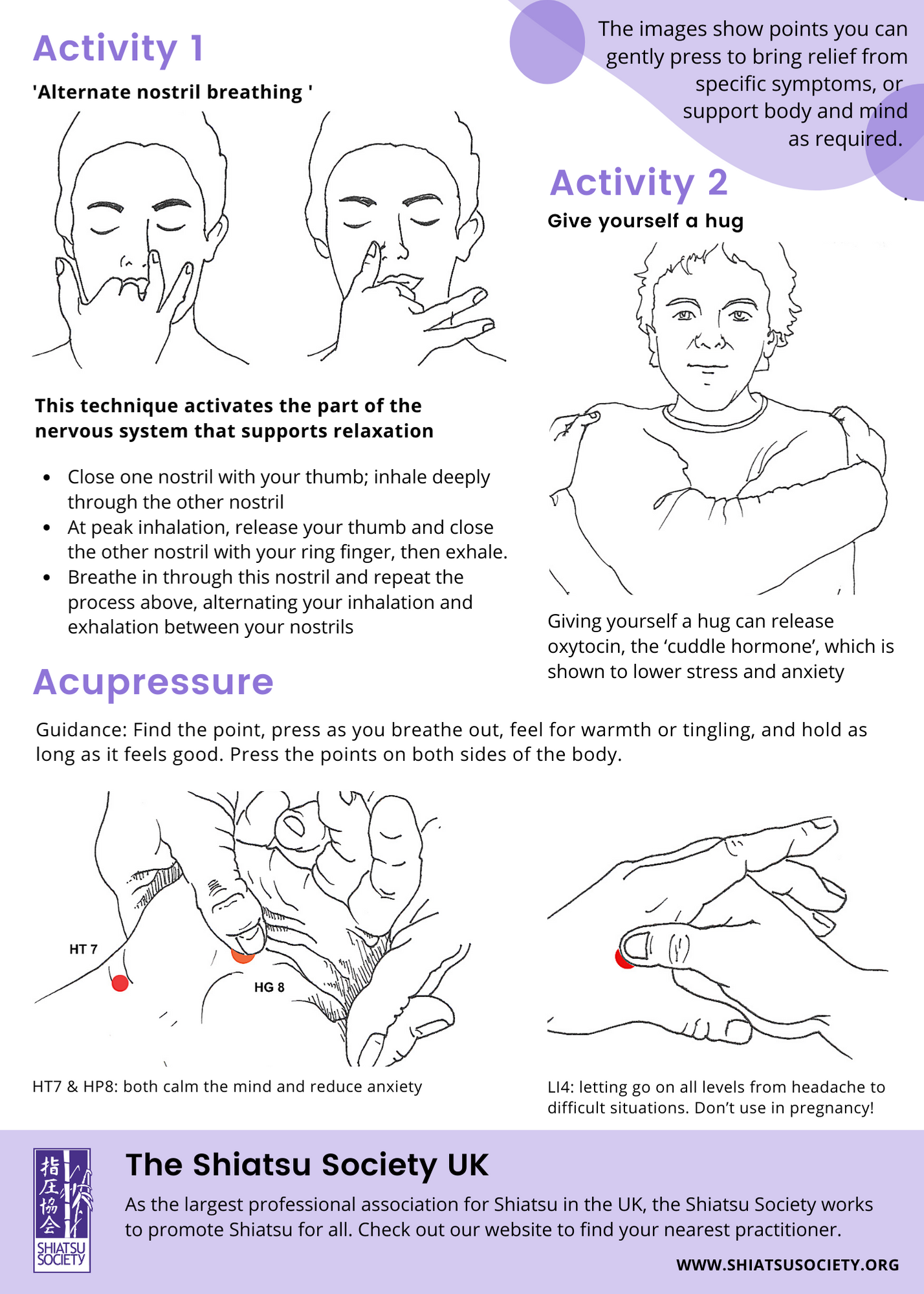
Acupressure & self-help techniques
Take a break
- Read a book or a magazine, even if it’s only for a few minutes.
- Run yourself a bath, watch a film, play with a pet or try out a new recipe.
Try active relaxation
Relaxation doesn’t have to mean sitting still. Gentle exercise can help you relax too.
Focus on your breathing
Learning to breathe more deeply can help you feel a lot calmer. It takes just a few minutes and can be done anywhere.
- Breathe in through your nose and out through your mouth. Try to keep your shoulders down and relaxed, and place your hand on your stomach – it should rise as you breathe in and fall as you breathe out.
- Count as you breathe. Start by counting ‘one, two, three, four’ as you breathe in and ‘one, two, three, four’ as you breathe out. Try to work out what’s comfortable for you.
You can find more details about this exercise on the NHS website.
Get creative
Getting in touch with your artistic side can help you feel more calm and relaxed.
Spend time in nature
Spending time outside and in green spaces can be great for your physical and mental health.
Picture yourself somewhere serene
Even if you can’t physically get away, your imagination can transport you to somewhere you feel calm.
- Think of somewhere relaxing and peaceful. You might choose a memory of somewhere you’ve been, or a place you have imagined.
- Close your eyes, and think about the details of this place. What does it look like? What kind of colours and shapes can you see? Can you hear any sounds? Is it warm or cool? Let your mind drift and your body relax.
Listen to music
Music can relax you, connect you to your emotions and distract you from worrying thoughts.
- Listen to your favourite songs. You could dance or sing along, or just close your eyes and enjoy.
- Really listen to the music. Can you pick out different instruments? Can you hear a drum beat or a certain rhythm? Focus on the music, and let other thoughts fade away.
Do a tech check
Technology can be great for helping you feel connected, but if you’re using it a lot then it can contribute to making you feel busy and stressed. Taking a break can help you relax, even if it is only short.
- Try turning your phone off for an hour, if you can.
- Step away from the TV, or have an evening where you don’t check emails or social networks. Use the time to do something relaxing. You could try some of the ideas above.
More help & advice can be found here www.mind.org.uk
BOOSTING ENERGY
Many cases of tiredness are due to stress, not enough sleep, poor diet and other lifestyle factors. Try these self-help tips to restore your energy levels.
If you feel you’re suffering from fatigue, which is an overwhelming tiredness that isn’t relieved by rest and sleep, you may have an underlying medical condition and you should consult a GP for advice.
Acupressure & self-help techniques
Eat often to beat tiredness
Get moving
You might feel that exercise is the last thing on your mind. But, in fact, regular exercise will make you feel less tired in the long run, so you’ll have more energy.
Even a single 15-minute walk can give you an energy boost, and the benefits increase with more frequent physical activity.
Lose weight to gain energy
If your body is carrying excess weight, it can be exhausting. It also puts extra strain on your heart, which can make you tired. Lose weight and you’ll feel much more energetic.
Sleep well
Many people don’t get the sleep they need to stay alert through the day.
Tips for sleeping well include:
- going to bed and getting up in the morning at the same time every day
- avoiding naps in the day
- taking time to relax before you go to bed
Reduce stress to boost energy
Stress uses up a lot of energy. Try to introduce relaxing activities into your day.
Cut out caffeine
Try to stay off caffeine completely for a month to see if you feel less tired without it.
You may find that not consuming caffeine gives you headaches. If this happens, cut down more slowly on the amount of caffeine that you drink.
Drink less alcohol
Although a couple of glasses of wine in the evening can help you fall asleep, you sleep less deeply after drinking alcohol.
Drink more water for better energy
Sometimes you feel tired simply because you’re mildly dehydrated. A glass of water will do the trick, especially after exercise.

Any holistic therapy should never be used as a substitution for medical treatment. Your General Practitioner should be consulted first if there is any doubt about your suitability for Shiatsu.
Please provide the practitioner with a complete and accurate health history.
The Practitioner may ask your General Practitioner for a letter if there are any major health concerns, which will confirm their agreement for Shiatsu sessions.
Follow Us
Opening Hours
Tuesday : 2pm - 7pm
Wednesday : 5.30pm - 9pm
Thursday : 6.30pm - 9pm
Friday : 2pm - 6pm
Phone
07980 007250
Address
Shifnal, Shropshire, UK